
It started with Wordle (guess the five-letter word) and then Worldle (guess the country), Heardle 1970s (guess the song) and now Birdle NZ (guess the Aotearoa bird). These daily puzzles are addictive, and when we get the answer immediately it confirms our brilliance – when we cannot get the answer in six guesses we usually dismiss it as unimportant.
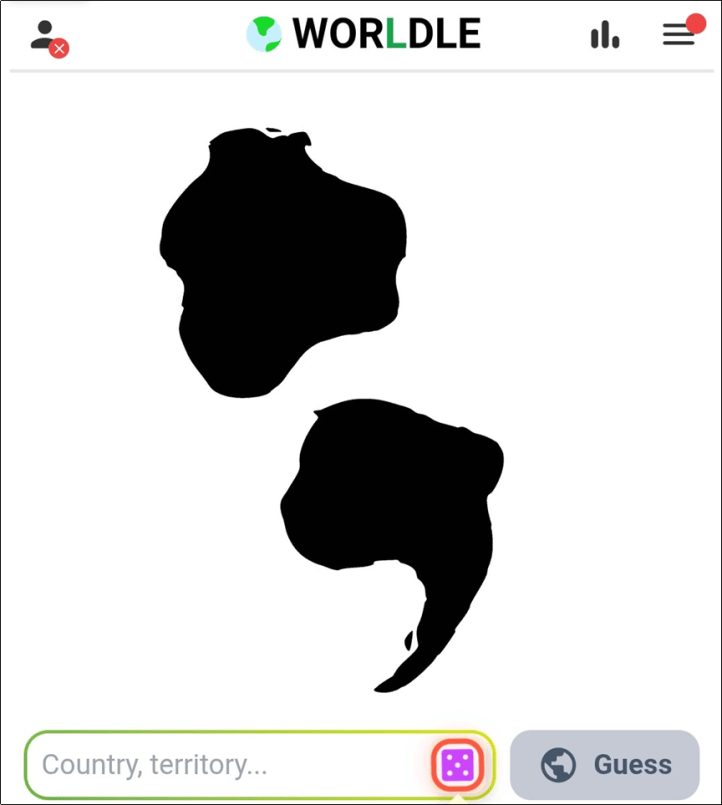
On April 1st we were stumped by Worldle. This game gives a country outline and then indicates the direction and distance of the target country from each country incorrectly guessed. The clues led us to a few hundred kilometres north of the Seychelles, in the Indian Ocean. We searched the atlas – nothing. Eventually, I gave up and just put in Madagascar, knowing it could not be true, and – April Fool!
But what was the origin of the fictitious country of San Serriffe? When I looked it up I found that it was a very successful April Fool’s hoax in 1977 by The Guardian, back when newspapers were printed on paper only. The seven-page supplement covered San Serriffe’s history, politics, geography, economy, and even its cultural and linguistic background. Evidently the ‘semi-colon’ shape was based on a map of Aotearoa New Zealand, and many of the names of people and places were from words from printing.
I became curious about the origins of some of the words. The name San Serriffe plays on the printing term ‘sanserif’, and its similarity to island names beginning with San, the Spanish word for ‘saint (masculine)’, usually shortened from Santo to San as in San Cristobel in the Solomon Islands. But in ‘sanserif‘, which is first recorded in the 18th century, the san probably comes from French sans/san ‘without’. This is compounded with ‘serif’, the small cross-strokes in typesetting or handwriting, which is from Dutch schreef meaning ‘line, stroke, mark’. Another theory is that ‘serif’ is a backformation from an original word ‘sanserif’ – people just assumed it was san+serif, much like the 14th century assumption that ‘a napron’ from French was an+apron. Since William Caxton began printing in Bruges before returning to England with the printing press, Dutch had an important influence on English printing (and spelling).
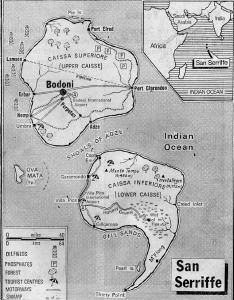
Map of San Serriffe1
The two islands of San Serriffe have pseudo French/Italian/English names: Caisse Superiore (Upper Caisse) and Caisse Inferiore (Lower Caisse). These again play on terms ‘upper case’ and ‘lower case’, from when the letters used in printing were in separate ‘cases’, with capitals in a higher case (from Latin capsa, ‘cylindrical case’).
Other references to printing in the hoax included the Indigenous Flong people, from flongs or papier mâché moulds used for making printing plates; the capital Bodoni from the font named after its18th century designer Giambattista Bodoni, and the president General Pica from the pica, a typographic unit of measure. My favourite is the name of the migratory birds to San Serriffe, the kwotes.
The ‘working language’ on San Serriffe is English, but the Indigenous language is Ki-Flong, and Caslon (after the first original English typeface) ‘is used for ceremonial occasions.’ I was interested to learn that the earliest stone inscriptions indicate that variants of the script of Ki-Flong have been found in Guatemala, indicating the geographical origins of San Serriffe as islands off the coast of Brazil:
It is thought that the language may have been modified in relatively recent times during the transit of the islands around the African coast.
After the supplement appeared in 1977 there was a rush on tourism bookings to San Serriffe. I would not be rushing to spend my holiday on an island nation which features beaches “where terrorism has been virtually eliminated”, but in 2026 it was fun to be fooled so completely.
 Language alive