
The Buddha Air ground staff checking us in for our flight from Kathmandu to Pokhara asked if we both wanted window seats. I said no thanks, it was fine to have us together – thinking that after all we are used to views of mountains. We Kiwis tend to feel a bit superior when we hear those from other countries talk about their mountains. To us, Mount Kozciuszko in Australia or Ben Nevis in the UK hardly rate in comparison with Aoraki (Mt Cook). But when we come to Nepal the mountains are so much higher than anything we are used to, and when we took off for Pokhara I was soon taking snaps out of the window.
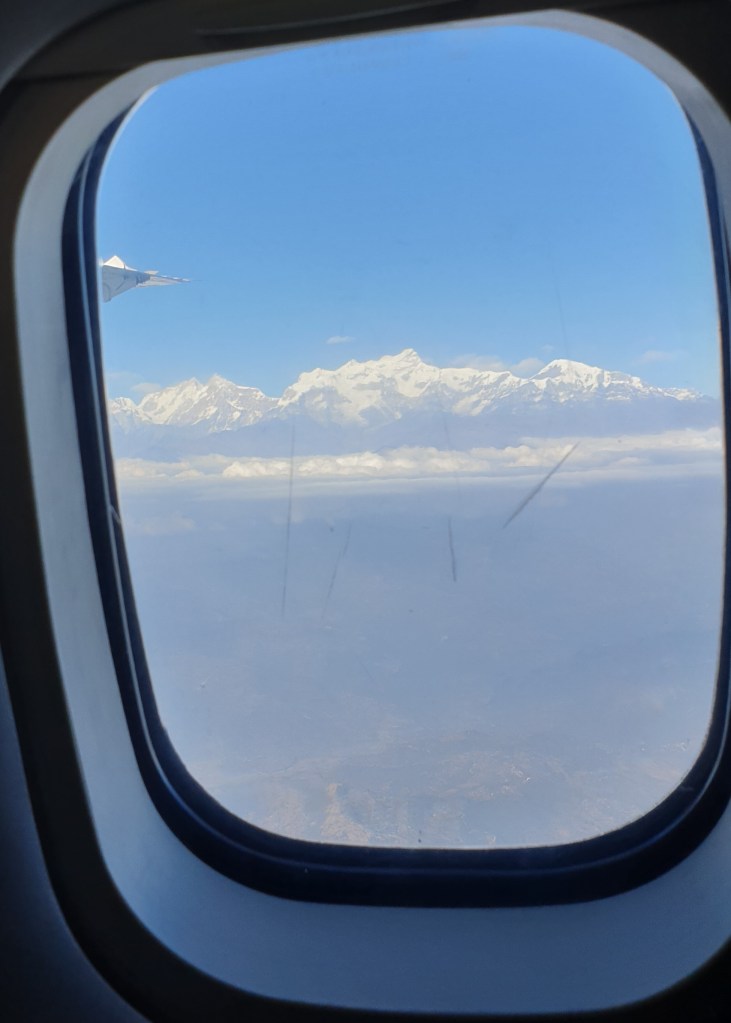
The Himalayas are हिमालय in the Devanagari script used to write Nepali and Sanskrit, from Sanskrit hima (snow, frost) and ālaya (house, abode). In Aotearoa they have a mystical place in the imagination of many people. All Kiwis know that it was the New Zealander Edmund Hillary together with Nepali Sherpa Tenzing Norgay who first climbed the highest peak – known in Nepali as Sagarmāthā (one translation is ‘sky head’), in Tibetan as Chomolungum (one translation is ‘goddess mother of the world’), and in English Mount Everest after an English surveyor who evidently actually wanted it to be called by a local name. In Pokhara I asked our Nepalese friend what his attitude was to the Himalayas when he was growing up. He said he couldn’t answer – they were just part of him.
I have never understood the wish to ‘conquer’ a mountain, probably because my innate unfitness (yes, I am sure that is a thing and no, I am not going to join a gym) means that I cannot climb even a hill without a lot of effort. Some years ago we were walking up to visit a primary school in the hills west of Pokhara and I had to stop for a rest and admire the view. Two women carrying large bundles of straw were coming up the path behind to pass us when they stopped to answer a phone call, putting down their loads.
After they had finished the call we exchanged greetings and I asked if I could try one of the bundles. I could hardly get it off the ground. This caused much laughter because I was nearly twice their height. However, they had no time to waste. They lifted the loads with little effort and strode off up the hill before I could even ask their names. My memory is that the road was cliff-like, but I must admit that in the photo it looks rather flat.

Farmers on the hill tracks near Pokhara
We did not see any men working in the paddy – we were told they were working in Dubai or other Emirates.
When we got to the school I asked the children about their sapanā (सपना), their dream for the future. They all immediately said they wanted to be doctors or pilots. I asked who would then grow the rice. They conferred and came up with the solution – they would be part-time farmers!
On this trip we again visited a school near Pokhara, this time unofficially. On a clear day the classrooms must have a spectacular view down the valley and towards the Himalayas, which we could just see through the top of the clouds.
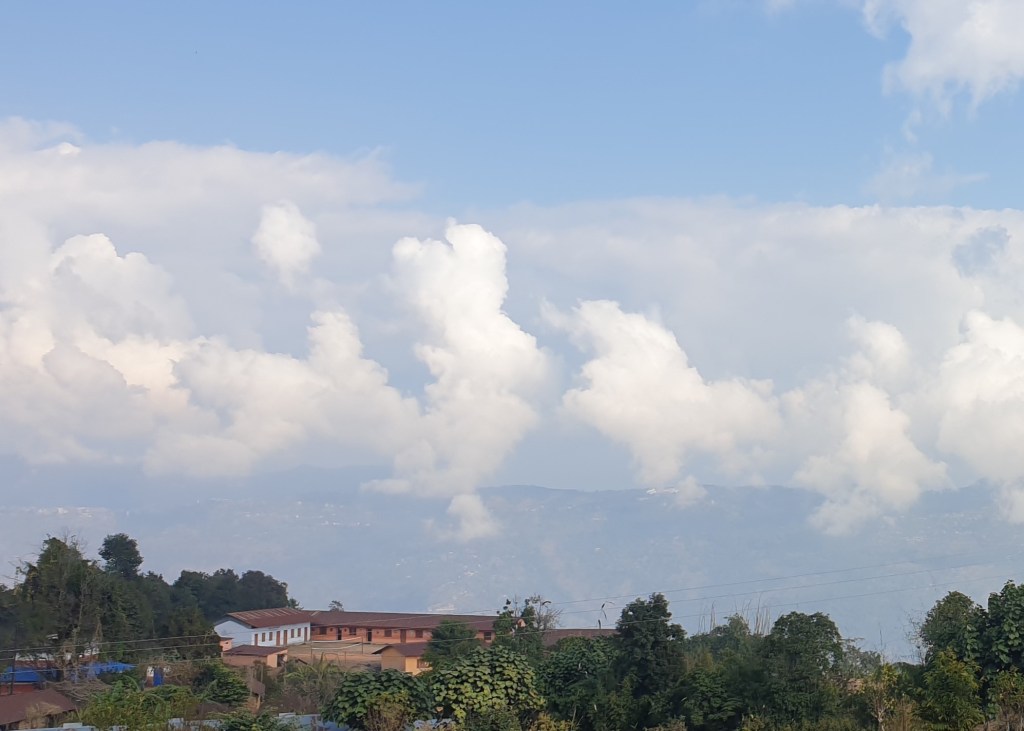
Shree Durga Basic School – a mountain tip can just be seen top left in the clouds.
Inside the classrooms there was not a lot to capture the children’s attention.
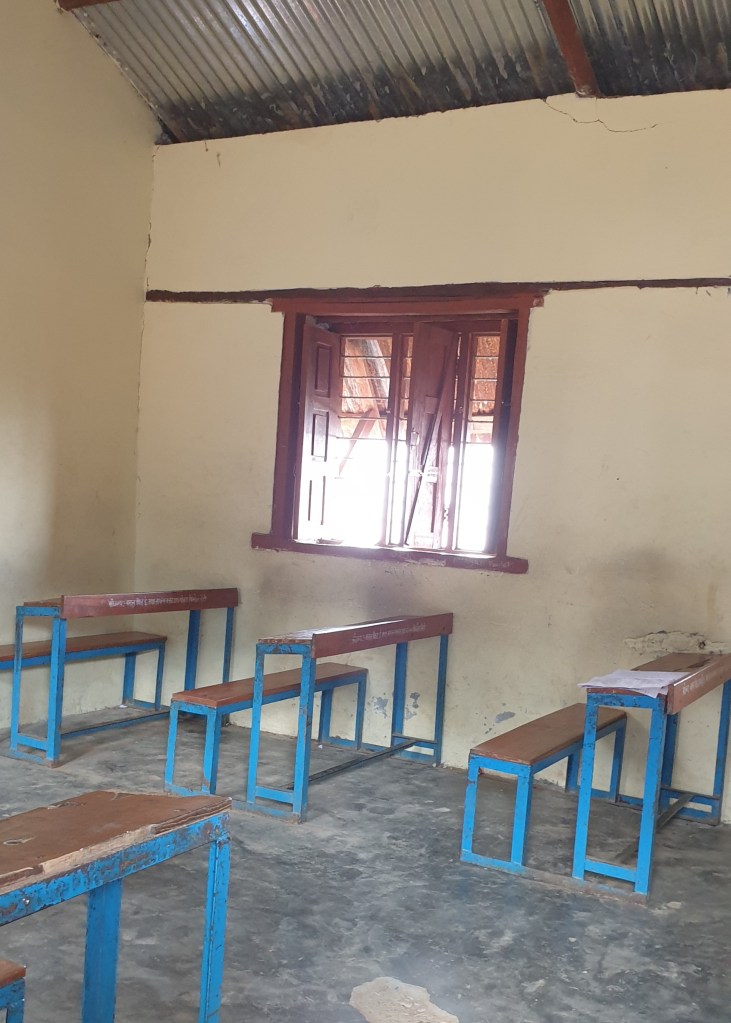
Classrooom at Shree Durga Basic School
Out in the playground, again I asked some children about their sapanā for the future. Panisha, a five-year old, answered immediately – her dream was to go overseas. Everyone laughed but it was hardly surprising when around a quarter of Nepal’s GDP is now from personal remittances and nearly a third of cultivated land is left fallow.

Panisha and Renuka
Panisha seems to have the determination to realise her sapanā. When she is a doctor in the UK or hotel manager in Dubai, I wonder if she will dream of the mountain views from the hills of Pokhara.
 Language alive
Great that they have those goals for the future!
It’s a bit sad the classroom is so bare.
LikeLike